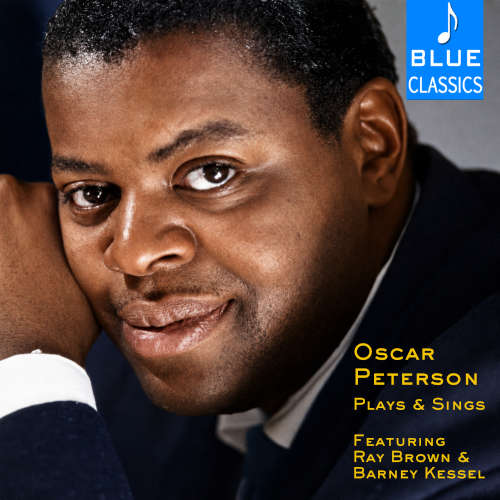
Title: OSCAR PETERSON PLAYS & SINGS
Year: 1953
Category: JAZZ,VOCAL,PIANO,BLUECLASSICS
- 1. Too Marvelous for Words 02:47
- 2. It Ain't Necessarily So 03:13
- 3. But Not for Me 02:27
- 4. The Man I Love 03:31
- 5. Strike Up the Band 03:15
- 6. Autumn in New York 03:57
- 7. Oh! Lady Be Good 03:50
- 8. I Can't Give You Anything But Love 03:05
- 9. 'S Wonderful 02:36
- 10. Somebody Loves Me 03:20
- 11. Things We Did Last Summer 03:58
- 12. I Got Rhythm 03:16
- 13. From This Moment On 02:54
- 14. A Foggy Day 03:37
- 15. Love Walked In 03:07
- 16. I Hear Music 02:27
- 17. Prelude to a Kiss 03:17
- 18. These Foolish Things 04:36
- 19. Fascinating Rhythm 02:57
- 20. Just A-Sittin' and Rockin' 03:41
- 21. One For My Baby (And One More for the Road) 03:14
- 22. Easter Parade 03:14
- 23. Cheek to Cheek 03:02
- 24. Polka Dots and Moonbeams 03:10
- 25. What Is This Thing Called Love 03:09
- 26. I've Got a Crush on You 02:53
- 27. I'm Glad There Is You 02:55
- 28. Long Ago and Far Away 03:46
- 29. Night and Day 03:40
- 30. Spring Is Here 02:45
- 31. I Was Doing All Right 02:37
- 32. Seven Come Eleven (Live) 03:51
- Tracks 1 & 3:
Oscar Peterson – piano & voice
Barney Kessel – guitar
Ray Brown – bass
Los Angeles, February 26, 1952
Tracks 2, 4–5, 7, 9–10, 12, 14–15, 17, 19–23, 25–26, 28–29, 31:
Oscar Peterson – piano
Barney Kessel – guitar
Ray Brown – bass
Los Angeles, 1952, primarily early December
Track 7:
Alvin Stoller – drums
Tracks 6, 8, 11, 16, 24, 27 & 30:
Oscar Peterson – piano & voice
Barney Kessel – guitar
Ray Brown – bass
New York, May 21, 1953
Tracks 13 & 18:
Oscar Peterson – piano & voice
Herb Ellis – guitar
Ray Brown – bass
Los Angeles, April 27, 1954
Track 32:
Oscar Peterson – piano
Herb Ellis – guitar
Ray Brown – bass
J. C. Heard – drums
Bushnell Memorial Auditorium, Hartford, Connecticut, May 1953

OSCAR PETERSON PLAYS & SINGS
by Oscar Peterson with Ray Brown, Barney Kessel
The recordings gathered here trace an important part of Oscar Peterson's early career, from his first recordings with Barney Kessel in 1952 through the development of the trio format that would soon become one of the defining ensembles of Peterson's career.
Peterson had already established himself as a professional musician in Canada before arriving on the American jazz scene. His early career included radio work in Montreal and regular performances with his own trio. His meeting with producer Norman Granz in 1949 led to appearances with Jazz at the Philharmonic and, soon afterwards, to regular recording activity for the labels associated with Granz.
The recordings with guitarist Barney Kessel belong to the period when Peterson was developing a piano–guitar–bass trio alongside Ray Brown. Kessel had already established himself as one of the leading guitarists of his generation and had worked with musicians associated with both swing and bebop. His guitar provided a different harmonic and rhythmic presence from that of a piano-bass duo, allowing Peterson greater freedom in the division of musical roles within the trio.
The earliest performances in this collection involving the three musicians date from 26 February 1952 in Los Angeles, including Peterson's vocal performances of Too Marvelous for Words and But Not for Me. Later that year, the trio recorded an extensive series of repertoire in Los Angeles, including the George and Ira Gershwin songs that would appear on Oscar Peterson Plays George Gershwin, as well as the Duke Ellington repertoire later issued on Oscar Peterson Plays Duke Ellington. The surviving session documentation places these recordings in early December 1952.
These December sessions produced a particularly broad selection of repertoire. Gershwin numbers such as Love Walked In, I Got Rhythm, A Foggy Day, Strike Up the Band, The Man I Love, It Ain't Necessarily So, I've Got a Crush on You, Oh, Lady Be Good, 'S Wonderful, Fascinating Rhythm, Somebody Loves Me, and I Was Doin' All Right were recorded by the Peterson–Kessel–Brown trio. Other sessions from the same period supplied Ellington compositions such as Prelude to a Kiss and Just A-Sittin' and A-Rockin', along with Cole Porter repertoire including Night and Day and What Is This Thing Called Love?
On 21 May 1953, Peterson returned to the studio in New York with Kessel and Brown for another group of recordings. This session produced several of the vocal performances associated with The Vocal Styling of Oscar Peterson, including I'm Glad There Is You, Polka Dots and Moonbeams, One for My Baby, I Hear Music, Autumn in New York, I Can't Give You Anything But Love, Spring Is Here, and The Things We Did Last Summer. The session was recorded at Fulton Studio in New York.
These recordings also illustrate Peterson's work as a singer as well as a pianist. His vocal performances were generally presented in the same small-group setting as his instrumental recordings, with the guitar and bass providing a compact accompaniment rather than a larger orchestral framework.
The partnership with Kessel was relatively brief. During 1953, Herb Ellis replaced Kessel as guitarist in Peterson's trio. Ellis had already developed a substantial career in swing and small-group jazz and would remain with Peterson and Ray Brown for the next several years. The trio of Peterson, Ellis and Brown subsequently became a regular presence on recordings and Jazz at the Philharmonic performances.
Two recordings in this collection show the transition particularly clearly. From This Moment On and These Foolish Things were recorded on 27 April 1954 in Los Angeles, with Peterson, Herb Ellis and Ray Brown. The latter was recorded in two takes, with take 3 becoming the version issued on Romance.
The final track takes us away from the studio. “Seven Come Eleven” was recorded live at the Bushnell Memorial Auditorium in Hartford, Connecticut, in May 1953, during a Jazz at the Philharmonic performance. By then Herb Ellis was the guitarist, with Ray Brown on bass and J. C. Heard on drums. The track documents the trio in a concert setting rather than the controlled environment of the studio sessions.
Taken as a whole, these recordings document a period in which Peterson's musical world was expanding rapidly. The material moves between vocal performances, instrumental standards, Gershwin and Ellington repertoire, and live jazz performance. It also captures a change in the personnel around Peterson: from his work with Barney Kessel and Ray Brown to the beginning of the partnership with Herb Ellis and Ray Brown.
The guitar trio format gave Peterson a flexible setting in which the three instruments could share melodic, harmonic and rhythmic functions. This became an important part of Peterson's recording career during the 1950s, with Ray Brown and Herb Ellis remaining closely associated with him throughout this period.
EU Public Domain Notice
The historical sound recordings included in this release are in the public domain in the European Union. Blue Music Group has created a new digital restoration and mastering of these historical recordings. The digital restoration and mastering by Blue Music Group are protected by applicable copyright and related rights. Rights may differ in other territories, including the United States. This release is not intended for distribution in the United States.
Cover artwork: The original photographic image has been legally assessed as being in the public domain in the EU following the expiry of the applicable 50-year term under Section 49a. The image has been restored, enhanced and colorized by Blue Music Group. © Blue Music Group. All rights reserved.